
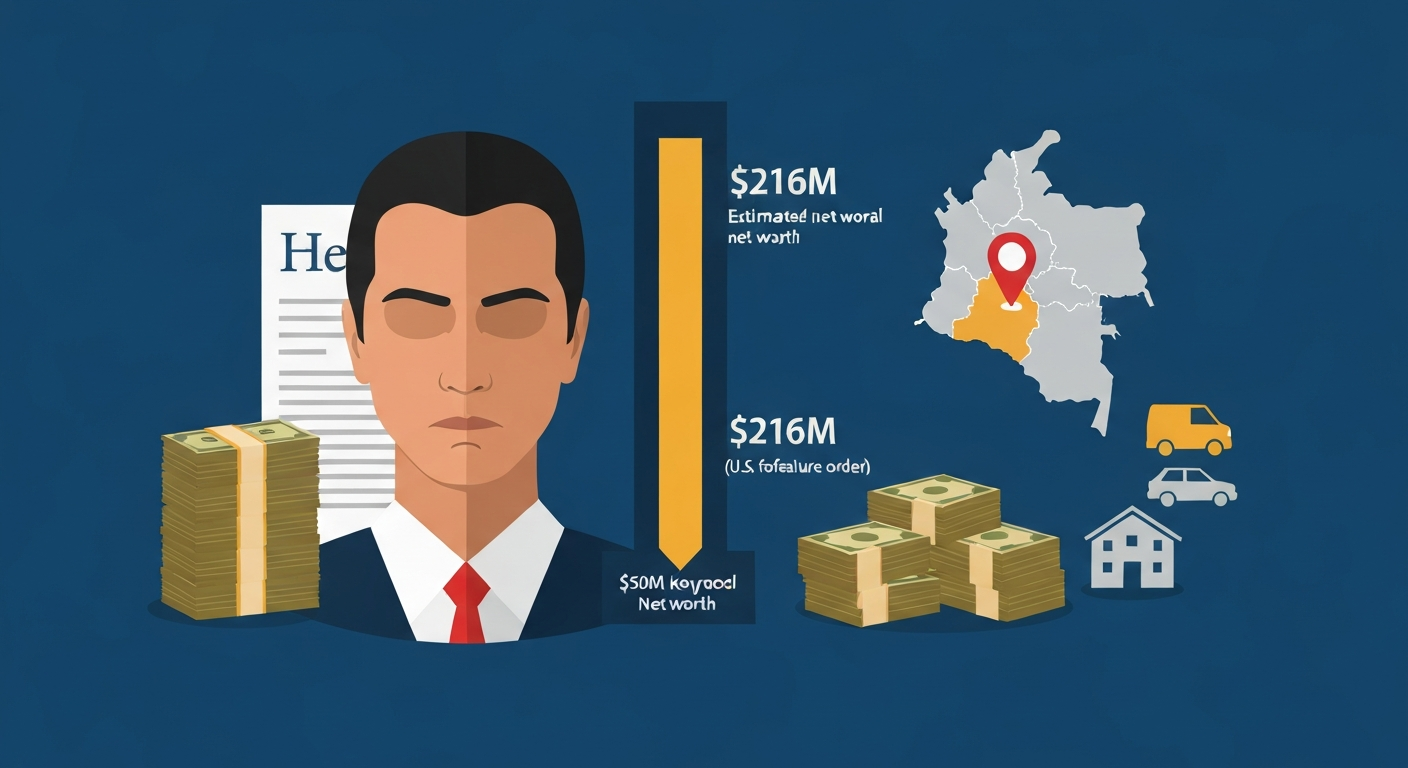
Based on court-ordered forfeiture judgments, Colombian asset seizure records, and U.S. prosecutor filings, the most defensible estimated net worth range for Dairo Antonio Úsuga David (alias "Otoniel") sits somewhere between $50 million and $200 million in personal accumulated wealth, with enormous uncertainty on both ends. A U.S. federal court ordered $216 million in forfeiture at his 2023 sentencing, and Colombian authorities have documented hundreds of millions of pesos in seized assets tied to him and his network. Those figures give us a floor, not a ceiling. What we cannot know is how much was already laundered, spent, transferred to associates, or hidden in ways that have never been traced.
Dario Antonio Usuga David Net Worth, Assets & Seizures

Carlos Reyes
23 Jul 2026
Executive Summary: The Estimate and Why It Comes With Caveats
Dairo Antonio Úsuga David led one of the most powerful and financially sophisticated drug trafficking organizations in the Western Hemisphere for roughly two decades. U.S. prosecutors described his organization, the Clan del Golfo (also known as the Urabeños), as a "multibillion-dollar" enterprise. That description refers to the organization's total revenue stream, not to one individual's personal net worth. Distinguishing between what the group earned collectively and what Úsuga personally accumulated and retained is the central challenge here, and honest research requires acknowledging that gap upfront.
| Metric | Figure | Source |
|---|---|---|
| Estimated personal net worth range | $50M – $200M (high uncertainty) | Derived from court filings, seizure records, and analyst estimates |
| U.S. federal court forfeiture order | $216,000,000 | DOJ / EDNY sentencing, Aug 8, 2023 |
| Colombian extinción de dominio seizures (reported) | ~USD $37.2M / COP 148,000M+ | SAE / Fiscalía / El Comercio, El País (Colombia) |
| 2026 Fiscalía operation (Antioquia) | ~COP 73,000M (~USD ~17M) | Infobae / Fiscalía, May 2026 |
| Organization characterized as | "Multibillion-dollar" enterprise | U.S. Attorney EDNY, May 2022 |
| U.S. federal prison sentence | 45 years | DOJ, Aug 8, 2023 |
The $50M–$200M range reflects what is traceable or inferable from public records. It is almost certainly an undercount of what flowed through his hands historically, and it may well be an overcount of what he personally retains in accessible form today, given his incarceration, extradition, and the extensive seizures already executed. We treat this as an open-ended estimate, not a precise figure.
Who Is He? Spelling Variants and the Search for "Otoniel"
If you landed here after searching any of several different spellings or names, you are in the right place. The subject's full legal name appears in official Colombian and U.S. court documents as Dairo Antonio Úsuga David, with an accent on the "U" in Úsuga. American media, DOJ press releases, and court filings often drop the accent and render it as Usuga. The first name appears in both official and informal sources as either Dairo or Dario (without the "i" in the first syllable). All of these refer to the same individual.
- Dairo Antonio Úsuga David (full legal name, Colombian spelling with accent)
- Dario Antonio Usuga David (common anglicized spelling in U.S. court documents and media)
- Dairo Úsuga / Dairo Usuga (shortened forms used by journalists and analysts)
- Otoniel (primary alias used by law enforcement, media, and the individual himself)
- "El Señor de los Sapos" and "El Curramba" (additional reported aliases used in criminal contexts)
- Clan del Golfo / Urabeños (the organization he led, sometimes used as a search shorthand)
For the remainder of this article, "Úsuga" and "Otoniel" are used interchangeably, as is standard in both U.S. government documents and Colombian press reporting. When we quote or reference specific source documents, we preserve the spelling used in that document.
How We Arrived at the Net Worth Estimate
Estimating the personal net worth of a convicted drug trafficker is fundamentally different from estimating the wealth of a musician or a business executive. There are no earnings disclosures, no property registries voluntarily filed, and no stock portfolios on record. What we have instead are four categories of evidence: court-ordered forfeiture amounts, documented asset seizures by Colombian and U.S. authorities, prosecutorial characterizations of organizational scale, and academic pricing frameworks applied to alleged shipment volumes.
The Court Forfeiture as a Baseline
The clearest single data point is the $216 million forfeiture ordered by a U.S. federal court at Úsuga's sentencing on August 8, 2023 in the Eastern District of New York. This is money a court determined was linked to criminal proceeds or must be surrendered as part of the sentence. It is important to understand what this figure means and what it does not mean. It does not represent the totality of what he earned. Prosecutors link forfeiture figures to traceable proceeds and conduct relevant to charges, not to a complete lifetime financial accounting. That said, a $216 million court judgment is a powerful anchor point: it confirms that U.S. law enforcement could substantiate proceeds at that scale from the evidence available.
Colombian Seizure Records
Colombian authorities, operating through the Fiscalía General de la Nación and the Sociedad de Activos Especiales (SAE), have documented multiple rounds of extinción de dominio (asset forfeiture) actions targeting properties linked to Úsuga and his associates. Media reports citing Fiscalía and SAE data describe 560 affected goods subjected to these measures, with a combined valuation reported by Colombian outlets at more than COP 148,000 million (roughly $37. El Comercio published 'Otoniel: Colombia expropia bienes por 37 millones de dólares al capo del Clan del Golfo, El Comercio (Perú)' reporting that assets valued at about $37.2 million were placed under administration by Colombia’s Sociedad de Activos Especiales (SAE) Otoniel: Colombia expropia bienes por 37 millones de dólares al capo del Clan del Golfo — El Comercio (Perú). 2 million USD at the exchange rates cited in coverage at the time). A separate operation reported by Infobae in May 2026 documented the seizure of more than 60 additional assets in Antioquia valued near COP 73,000 million, adding another estimated $17 million or more to the documented tally. These are assets from within the Clan del Golfo's network; not all are attributable exclusively to Úsuga personally, which is a consistent complication in cartel-leader net worth estimates.
Organizational Scale and Inference
U.S. prosecutors alleged in superseding indictment documents that Úsuga's organization distributed approximately 75,000 kilograms of cocaine across 31 incidents for importation into the United States during the 2003–2012 period alone. Using published academic price ranges from research on cocaine supply networks, roughly $4,500 per kilogram at the Colombia-Panama border and $24,000 per kilogram at U.S. wholesale levels, those 75,000 kilograms translate to gross commodity values of between $337.5 million and $1.8 billion at different points in the chain. These are illustrative figures, not the personal income of one individual. A cartel leader typically captures a fraction of gross commodity value after paying suppliers, transporters, enforcers, lawyers, bribes, and operational costs. Analysts and prosecutors typically attribute leadership-level captures of anywhere from a few percent to perhaps 15–20 percent of gross proceeds in large organizations, though this varies widely and is inherently speculative.
Applying even a conservative leadership capture rate to the low end of those gross estimates produces figures well above the documented seizures, which supports the view that the traceable asset record substantially undercounts Úsuga's historical accumulation. Where the rest of that money went, whether laundered into untraceable forms, distributed to associates, consumed in operations, or hidden in ways investigators have not yet surfaced, is unknown.
Where the Money Allegedly Came From
U.S. government charging documents and public statements from the DOJ, DEA, and U.S. Treasury describe a layered business model for the Clan del Golfo under Úsuga's leadership. This is not a simple "drug dealer" operation. It is a diversified criminal enterprise with multiple revenue streams, some more visible than others.
Cocaine Trafficking: The Core Business
The dominant revenue stream, by every account, was cocaine. The Clan del Golfo operated across Colombia's northwestern corridor, one of the country's most critical cocaine transit zones, controlling territory through which cocaine produced by smaller groups was consolidated and exported. The organization both produced cocaine directly and taxed independent producers operating in its territory. U.S. prosecutor descriptions characterize it as a "multibillion-dollar" operation. The 75,000 kg alleged in the 2003–2012 indictment period reflects only the charges brought in a U.S. court, not the organization's total export volume over Úsuga's full tenure as leader, which ran from roughly 2012 until his capture in October 2021.
Territorial Taxation and Extortion
A critical but less visible revenue stream was systematic extortion and "taxation" of economic activity in territories the Clan del Golfo controlled. This included fees levied on businesses, transportation, agricultural operations, and other criminal groups moving product through their corridors. Colombian press reporting and investigative outlets like InSight Crime document this as a major ongoing revenue mechanism that generated cash income independent of actual drug shipments. This kind of revenue is among the hardest to trace or quantify because it is transactional, cash-based, and geographically dispersed.
Illegal Mining
U.S. government filings and investigative journalism describe the Clan del Golfo's involvement in illegal gold mining in Colombia's Chocó and Antioquia departments. This represents a significant diversification from pure drug revenue and is consistent with the organization's territorial control model: the group taxed or directly controlled informal mining operations in areas under its influence. Gold provided a commodity with established export markets and some degree of natural money-laundering utility given the difficulty of distinguishing legally from illegally sourced gold in trade flows.
Money Laundering and Business Fronts
Conversion of cash proceeds into traceable legitimate assets is the mechanism that produces the kind of property holdings that appear in extinción de dominio records. Colombian investigators and the SAE have identified real estate, vehicles, and commercial businesses subjected to asset forfeiture proceedings linked to Úsuga and his network. The use of front companies and nominee ownership structures (where properties are registered in the names of relatives, associates, or legal entities) is documented in both Colombian Fiscalía filings and in the descriptions of the 560-plus assets subjected to forfeiture measures. The 2014 operation reported by El Tiempo, which found COP 5,400 million in cash at a property linked to relatives and associates, illustrates both the cash volumes in play and the practice of distributing assets across a network to complicate tracing.
Documented Assets and Government Seizures
The following represents the documented public record of asset seizures tied to Úsuga and his network. These are the concrete, source-supported items we can report with confidence. Values are approximate and subject to exchange rate variations between the periods reported.
| Seizure / Action | Approximate Value | Authority | Date / Period |
|---|---|---|---|
| Extinción de dominio on 560+ assets (Otoniel / alias Nicolás network) | COP 148,000M+ (~USD $37.2M) | Fiscalía / SAE Colombia | Multiple actions, reported cumulatively |
| Cash found at property linked to relatives/associates | COP 5,400M (~USD ~$1.4M) | Colombian authorities | 2014 operation |
| 60+ assets seized in Antioquia (homes, companies, vehicles) | ~COP 73,000M (~USD ~$17M) | Fiscalía Colombia | May 2026 |
| U.S. federal court forfeiture judgment | USD $216,000,000 | U.S. District Court / EDNY | Aug 8, 2023 |
| OFAC asset blocking / SDN designation | All U.S.-jurisdiction property blocked | U.S. Treasury / OFAC | Dec 1, 2020 |
An important qualification: extinción de dominio proceedings in Colombia target assets "linked to" a criminal network, which can include properties nominally owned by associates, family members, or front companies. The 560-plus figure represents assets within the network's sphere, not a catalog of items legally registered in Úsuga's own name. The SAE administers these properties after seizure, managing them for eventual liquidation or repurposing rather than immediately converting them to cash at full market value. Real-world recovery by the state is often lower than the stated valuation of seized assets.
Timeline: Key Financial and Operational Milestones
- Early 2000s: Úsuga joins paramilitary structures affiliated with the AUC (Autodefensas Unidas de Colombia), gaining early access to criminal revenue networks in northwestern Colombia.
- 2006: Following AUC demobilization, Úsuga and his brother Juan de Dios Úsuga David (alias 'Giovanni') helped reconstitute a successor criminal organization, later branded the Urabeños, laying the foundation for what became the Clan del Golfo.
- 2012: Juan de Dios Úsuga is killed by Colombian security forces; Dairo/Otoniel assumes sole leadership of the Clan del Golfo and consolidates its territorial and financial operations.
- 2014: Colombian authorities raid a property linked to Úsuga's relatives and associates, discovering COP 5,400 million in cash — one of the earliest documented large-scale cash seizures from his network.
- 2020 (December 1): U.S. Treasury's OFAC adds Dairo Antonio Usuga David (Otoniel) and Clan del Golfo entities to the SDN list under Foreign Narcotics Kingpin Act authorities, blocking all U.S.-jurisdiction assets and prohibiting U.S. persons from transacting with him.
- 2021 (October 23): Colombian security forces capture Úsuga in an operation in Urabá, Antioquia. The Colombian government describes it as the most significant capture in the country's history. Asset-targeting operations intensify following the capture.
- 2022 (May 5): Úsuga is extradited from Colombia to the United States to face federal charges in the Eastern District of New York. The U.S. Attorney's office publicly describes the Clan del Golfo as a 'multibillion-dollar' drug trafficking organization.
- 2023 (August 8): Úsuga is sentenced to 45 years in U.S. federal prison and ordered to pay $216 million in forfeiture, the most concrete single financial figure in the public record.
- 2026 (May): The Colombian Fiscalía reports a new round of seizures in Antioquia, incautando more than 60 assets (homes, companies, high-value vehicles) valued at approximately COP 73,000 million from networks connected to the Clan del Golfo.
Legal Status and What It Means for His Finances
As of the writing of this article in July 2026, Dairo Antonio Úsuga David is serving a 45-year sentence in U.S. federal custody following his conviction in the Eastern District of New York. He was extradited from Colombia in May 2022 after being captured there in October 2021. The sentence was handed down on August 8, 2023, and includes the $216 million forfeiture judgment. He has no realistic path to managing personal finances or accessing criminal networks in any meaningful operational capacity from federal prison.
The OFAC SDN designation remains in effect, meaning any property in U. The U.S. Treasury’s Office of Foreign Assets Control (OFAC) placed Dairo Antonio Usuga David (a.k.a. “OTONIEL”) and the Clan del Golfo on sanctions/SDN lists, blocking property and prohibiting U.S. transactions with him and listed entities OFAC designated Dairo Antonio Usuga David ("OTONIEL") and the Clan del Golfo on its Specially Designated Nationals (SDN) list, blocking property and prohibiting U.S. transactions with them.. S. jurisdictions connected to him is blocked, and U.S. persons and institutions are prohibited from transactions involving him or listed entities. The Colombian extinción de dominio proceedings are ongoing: asset seizures reported as recently as May 2026 confirm that Colombian authorities continue to pursue assets tied to the Clan del Golfo network even after his incarceration. Any wealth that was not seized or successfully hidden prior to his capture has been substantially impaired by these combined legal actions.
The practical financial consequence: whatever personal wealth Úsuga accumulated that was traceable is either subject to forfeiture, already seized, or blocked by sanctions. What remains inaccessible to authorities, money laundered into non-traceable forms, assets held by loyalists under arrangements outside documented networks, or cash hidden prior to capture, is by definition unknown and unquantifiable from public sources.
How This Estimate Compares to Similar Figures
To give the $50M–$200M range meaningful context, it helps to compare it to similar cases in the same criminal and geographic category. The most commonly cited comparable is Pablo Escobar, whose peak personal fortune was estimated by Forbes in the early 1990s at around $3 billion, with some contemporaneous estimates higher. The scale difference is significant and partly reflects the structural evolution of cocaine trafficking: by the time the Clan del Golfo was dominant, cartels in the Colombian model had fragmented into smaller, more distributed organizations where no single leader accumulated Escobar-era concentrations of personal wealth. The Clan del Golfo under Úsuga operated more as a federated criminal enterprise than a vertically integrated personal empire.
Among more recent Latin American criminal leaders, the comparison to Joaquín "El Chapo" Guzmán is instructive. U.S. prosecutors sought $12.6 billion in forfeiture from Guzmán at his 2019 sentencing (though the government acknowledged collecting far less), and his organization was described as generating revenues in the billions annually for decades. The $216 million forfeiture ordered against Úsuga is substantially smaller, consistent with the Clan del Golfo being a powerful regional organization but not the dominant trans-continental operation that the Sinaloa Cartel represented at its peak.
For readers comparing these profiles to those of legitimate Latin American public figures on this site, the wealth context is entirely different. Profiles of political leaders and figures like those covered elsewhere on Hispanic Net Worth represent publicly accountable, legally sourced wealth, which is inherently more transparent and verifiable. For a point of comparison with publicly reported private-wealth profiles in the region, see the Yuniesky Betancourt net worth profile. For examples of transparent, publicly accountable wealth reporting on this site, see Yuey Tan net worth. For a contrast with a publicly accountable figure, see the profile on the president of Uruguay net worth. For example, our profile on Pepe Mujica net worth shows how we document legally sourced public-figure wealth using transparent, verifiable records. Criminal wealth estimates like this one are necessarily less precise and carry fundamentally different ethical weight.
What We Cannot Know: Limitations and Ethical Caveats
Researching and publishing an estimated net worth for a convicted drug trafficker raises legitimate questions that are worth addressing directly. The first is methodological: every figure in this article is either a government-documented seizure or forfeiture amount, a prosecutorial characterization, or a range derived by applying published academic price frameworks to prosecutor-alleged shipment volumes. None of these are Úsuga's own financial disclosures. The estimate is built from the outside in, not from verified personal financial records, and should be read with that limitation clearly in mind.
The second limitation is the gap between organizational and personal wealth. The Clan del Golfo being a "multibillion-dollar organization" does not mean Úsuga personally retained billions. Cartel economics involve significant costs: payments to fighters, bribes to officials, operational logistics, legal representation, and losses from seizures. The leader's personal share of gross revenue is always smaller than the headline organizational figure, and in federated criminal structures it can be much smaller than people assume.
The third limitation is structural opacity. Money laundering by definition obscures ownership. Assets held through nominees, informal trusts, or foreign jurisdictions may never appear in any public record. Colombian extinción de dominio proceedings capture what investigators can identify and prove; they do not capture what was successfully hidden. We do not speculate about hidden assets beyond noting that the gap between documented seizures and inferred gross proceeds is large enough to suggest significant untraced wealth.
On the ethical side: publishing this profile is not an endorsement or glorification of Úsuga's activities. The purpose is informational, helping researchers, journalists, students, and curious readers understand the financial mechanics and documented scale of organized crime in Latin America. Understanding how criminal wealth is constructed, laundered, and dismantled is relevant to public policy, journalism, and academic research. We present the documented facts, the honest limitations, and the sourced estimates without sensationalizing.
Common Reader Questions
Is Otoniel the richest drug lord in history? No. By every available measure, his personal accumulated wealth was substantially smaller than that of Pablo Escobar at peak or Joaquín Guzmán at peak. He led a powerful regional organization, but the era of hyper-concentrated cartel wealth tied to a single leader had largely passed by the time he rose to the top.
Did the $216 million forfeiture order mean the U.S. government collected $216 million? Not necessarily, and not immediately. Forfeiture judgments represent what a court orders; actual collection depends on locating and seizing assets. The DOJ does not typically publish real-time collection figures for individual forfeiture judgments. The judgment establishes the legal obligation; enforcement is a separate process.
Are the Colombian peso figures reliable conversions? The COP figures cited come from Colombian media reporting at various points in time. The USD equivalents we cite reflect approximate conversions at the exchange rates prevailing when those reports were published. Given Colombia's exchange rate fluctuations over the period, readers should treat the USD equivalents as rough orders of magnitude rather than precise current values.
Could his family or associates still control significant hidden assets? That is both possible and, frankly, likely to some degree. Successor leadership of criminal organizations almost always includes some degree of financial continuity. Colombian Fiscalía operations reported as recently as May 2026 are specifically targeting assets tied to networks associated with Úsuga, which suggests authorities believe meaningful undiscovered wealth remains in those networks. How much is personally attributable to Úsuga versus successor leaders and associates is impossible to say from public sources.
FAQ
What is the best transparent estimate of Dairo/Dario Antonio Úsuga/Usuga David (alias “Otoniel”)’s net worth?
Based on public court orders, prosecutor statements, documented seizures and media reporting, a conservative, research‑driven estimate is that Otoniel’s personal net worth is most plausibly in the low tens of millions up to the low hundreds of millions of U.S. dollars. A useful working range for reporting purposes (with clear uncertainty) is roughly US$50 million to US$500 million. This range reflects: (a) the U.S. court‑ordered forfeiture/ money judgment of US$216 million tied to him (DOJ sentencing, Aug 8, 2023), (b) multiple Colombian seizures and extinción de dominio actions (media and prosecutor figures in the tens of millions of USD converted from COP), and (c) the scale of alleged drug shipments prosecutors use to frame organizational revenue. It does not claim precision — the true amount could be lower if much was already seized or higher if substantial hidden offshore holdings remain undiscovered.
Why isn’t a single exact net worth figure provided?
Estimating the wealth of alleged criminal actors faces major evidentiary gaps: (1) courts’ forfeiture judgments represent amounts prosecutors can legally link or seek to recover, not definitive measures of personal lifetime take; (2) assets may be hidden in informal networks, offshore entities, or under relatives’ names; (3) reported seizure valuations vary by source, currency conversion and whether values are book/administrative estimates or market prices; and (4) public records and charging documents do not disclose all flows or private holdings. For those reasons we present a reasoned range with stated sources rather than an exact number.
What primary evidence supports the estimate (key documented figures)?
Key public evidence: (1) U.S. Department of Justice sentence (Aug 8, 2023) with a US$216,000,000 forfeiture/judgment; (2) U.S. prosecutors described the Clan del Golfo as a “multi‑billion‑dollar” organization at extradition (EDNY, May 2022); (3) superseding indictments allege roughly 75,000 kg of cocaine distributed for U.S. importation in 2003–2012 (used to infer scale); (4) OFAC Kingpin designation (Dec 1, 2020) blocking property/transactions; (5) Colombian extinción de dominio and SAE/Frisco asset administration actions, with media‑reported public valuations (examples: COP ~148,000 million aggregate figure reported; USD ≈ $37.2M and subsequent seizures reported ~COP 73,000 million in 2026); (6) earlier on‑site cash seizures reported by Colombian outlets (e.g., COP 5,400 million in 2014). These items form the empirical foundation for the range above.
How do alleged income streams (drug trafficking, extortion, money‑laundering, fronts) factor into the estimate?
Prosecutors and Treasury characterize the Clan del Golfo’s business model as: (a) large‑volume cocaine production and export (primary revenue), (b) taxation/‘fees’ on producers, transporters and local businesses in controlled territory, and (c) ancillary criminal income (extortion, illegal mining, smuggling). Estimates translate alleged shipment volumes (e.g., the 75,000 kg figure prosecutors cite) into gross market values using academic wholesale price bands (approx. US$4,500/kg at source/transit to ~US$24,000/kg at U.S. border). Those conversions show organizational gross revenue potentially in the hundreds of millions to billions of dollars, but a leader’s personal capture of that revenue is a smaller, uncertain slice subject to dissipation, reinvestment, and seizure. Money‑laundering and business fronts (reported companies, real estate, vehicles) are the mechanisms by which proceeds were alleged to be converted into assets and thus inform asset‑based estimates.
What known assets and government seizures are on record?
Public records and media reporting indicate multiple asset‑targeting actions: (a) Colombian extinción de dominio measures affecting hundreds of goods with public valuations reported (examples include an aggregate figure reported by El País of COP 148,000 million and specific SAE/Frisco administrations of assets); (b) media reports of Colombian expropriations valued at about US$37.2 million (El Comercio); (c) Infobae reporting of more than 60 assets seized valued near COP 73,000 million (May 2026) including homes, companies and high‑value vehicles; (d) reported onsite cash seizures (El Tiempo reported COP 5,400 million in 2014 linked to associates); and (e) OFAC sanctions and U.S. forfeiture/judgment (US$216M) blocking identified U.S.‑linked property and transactions. Many seized items are administered by Colombia’s Sociedad de Activos Especiales (SAE) rather than immediately sold.
How should the U.S. $216,000,000 forfeiture be interpreted relative to net worth?
The US$216 million forfeiture ordered at sentencing (DOJ, Aug 8, 2023) represents the sum a U.S. court determined was forfeitable or linked to criminal activity in the case as presented by prosecutors. It is a legally significant figure but not necessarily equal to Otoniel’s total historical wealth. Forfeiture reflects amounts traceable under the indictment and what prosecutors sought to recover; it can understate or overstate total lifetime proceeds depending on what was provably linked, what remains hidden, and what domestic/foreign authorities have seized separately.