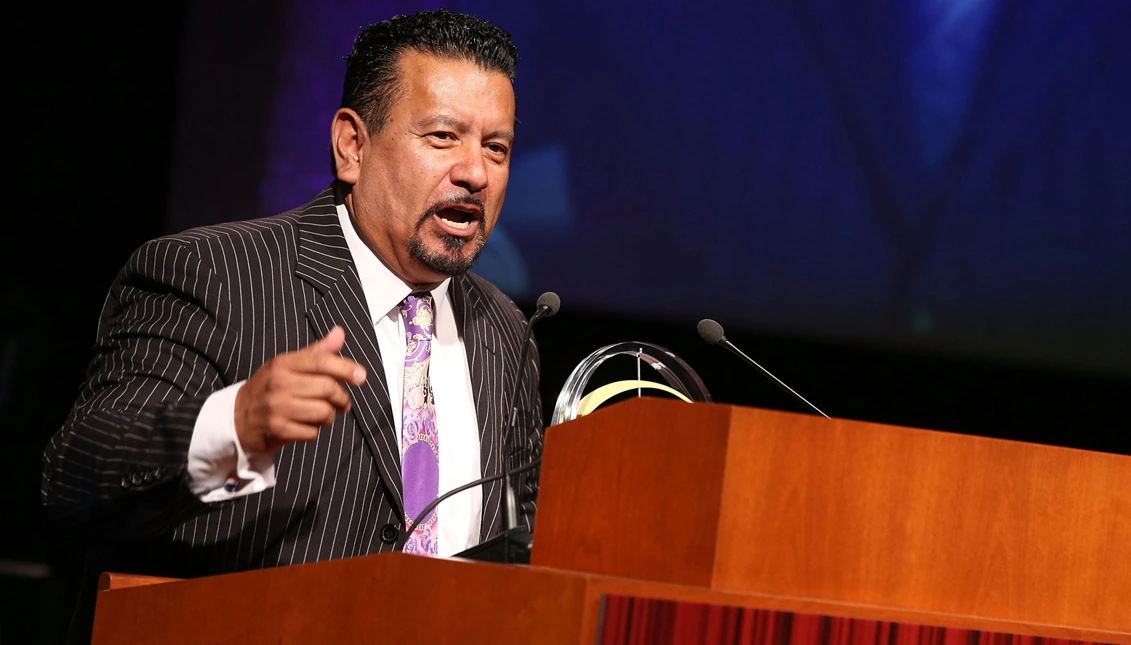
Who Richard Montañez is and why people want to know his net worth

Richard Montañez is a Mexican-American businessman and motivational speaker who rose from working as a janitor at a Frito-Lay plant in Rancho Cucamonga, California, to become a Vice President of Multicultural Sales and Marketing at PepsiCo, overseeing multiple North American divisions. He retired from that role on March 1, 2020, according to his official biography. His story became extraordinarily prominent when the Hulu/Disney+ film "Flamin' Hot" dramatized his claim that he invented Flamin' Hot Cheetos in the early 1990s. That narrative, whether you accept every detail or not, made him one of the most recognizable Hispanic success stories in American corporate history.
The financial interest is understandable. His is a rags-to-corporate-VP arc, he's authored a memoir, he commands serious speaking fees, and a major studio made a film about him. For readers on this site, he's also a significant figure in the context of Hispanic and Latin American wealth representation, which is exactly the kind of financial story worth documenting carefully.
The dispute over his inventor claim, including a federal lawsuit that was dismissed in May 2025, adds another layer that shapes how we should think about his finances. Wikipedia’s film page for “Flamin’ Hot” describes the authenticity dispute around Montañez’s inventorship and notes that it was raised after reporting, including the Los Angeles Times investigation, putting the film’s “true story” framing in context the dispute over his inventor claim.
How net worth estimates like this one are built
For public figures who aren't billionaires or executives at publicly traded companies, net worth is almost always an estimate, not a disclosure. Richard Montañez has never published a personal balance sheet, and he's not required to. What researchers and aggregator sites do is piece together publicly available information: salary ranges for his corporate title, disclosed speaking fees, book deal and royalty norms, and any documented assets or business interests. From that patchwork, they arrive at a figure.
To understand what a serious net worth estimate includes, it's worth looking at how organizations like Forbes approach this for their own lists. Forbes methodology for the Forbes 400, for example, accounts for stakes in public and private companies, real estate, art, and other hard assets, all valued as of a specific date. For someone like Montañez, who is not on that list, we apply the same categories but with much less direct data: estimated career savings from a long PepsiCo executive career, estimated speaking income, book royalties, and any real estate or investment assets that can be reasonably inferred. What's excluded from reliable estimates: speculative lawsuit windfalls, unverified business ventures, and any figures that can't be traced to a documented source.
Sites like CelebrityNetWorth, which Wikipedia notes relies on a "proprietary algorithm" based on publicly available information, have faced scrutiny for their methodology. They are not authoritative financial disclosures. When you see a round number like $15 million cited without a breakdown, that's a convergence of estimates, not a confirmed valuation. The 2025 net worth picture for Richard Montañez reflects a similar methodology, and it's worth understanding the assumptions behind it before treating any figure as definitive.
Where his money likely comes from

Breaking down Montañez's probable income streams helps explain why $15 million is a reasonable, if imprecise, ballpark. Here's how the pieces fit together.
Executive career at PepsiCo
Montañez worked at Frito-Lay and PepsiCo for roughly three decades, eventually reaching Vice President level. Senior vice presidents at major consumer goods companies typically earn well into the six figures annually, often $200,000 to $400,000 or more when bonuses and stock compensation are included, though his exact compensation was never publicly disclosed. Over a career spanning that many years, cumulative savings and retirement benefits from a role of that seniority would represent a meaningful foundation for his overall net worth.
Professional speaking fees

Since retiring in 2020, speaking has clearly become a primary income driver. Speaker bureau listings put his in-person fee range at $20,000 to $50,000 per appearance, depending on the agency and event type. Virtual events are listed at $10,000 to $20,000. If he's doing even 20 to 30 events per year at those rates, which is realistic for a motivational speaker of his profile, that alone generates $400,000 to $1.5 million annually before taxes and agency commissions. Over several years, this adds up materially.
Book royalties and author income
Montañez published his memoir "Flamin' Hot" with Penguin Random House, which is a major publisher that typically pays advances ranging from modest five figures to well into six figures for books tied to high-profile stories. His earlier book, "A Boy, a Burrito, and a Cookie" (2013), preceded the film adaptation. The Hulu/Disney+ film based on his story, directed by Eva Longoria, almost certainly gave his book sales a significant boost. Royalty income on a successful trade book runs roughly $1 to $3 per copy sold. Without sales figures, this is hard to pin down, but it's a real and recurring income stream.

When a major studio adapts your life story, you typically negotiate rights fees and sometimes back-end participation. The specifics of Montañez's deal with Searchlight Pictures (the Fox Searchlight subsidiary that produced "Flamin' Hot") were not publicly disclosed, but story rights fees for this kind of project can range from low six figures to much more, depending on the deal structure. This is a one-time or episodic income event, not a recurring one, but it can be material.
Major financial milestones and publicly documented facts
Putting a timeline on the key verified events helps anchor the net worth estimate to reality rather than myth.
- Started as a janitor at Frito-Lay's Rancho Cucamonga plant (1970s–1980s), meaning his wealth accumulation from the company began relatively late as he moved into sales and marketing roles.
- Climbed to Vice President of Multicultural Sales and Marketing at PepsiCo, overseeing multiple North American divisions, a position that carried significant compensation for the final years of his career.
- Retired from PepsiCo effective March 1, 2020, transitioning fully to speaking and author work.
- Published the memoir "Flamin' Hot" with Penguin Random House, which became the basis for the 2023 film.
- The 2023 Hulu/Disney+ film "Flamin' Hot," directed by Eva Longoria, brought massive mainstream attention to his story and almost certainly boosted both speaking demand and book sales.
- In May 2021, the Los Angeles Times reported that Frito-Lay disputed his claim to have invented Flamin' Hot Cheetos, which became an ongoing public controversy.
- In May 2025, a federal judge dismissed Montañez's lawsuit related to the Flamin' Hot Cheetos origin claims, meaning no large litigation settlement or judgment is now a realistic financial factor in his net worth.
That last point matters more than it might seem. Before the dismissal, some speculative estimates might have quietly factored in a possible lawsuit settlement. With that door closed as of May 2025, the realistic wealth picture is one built entirely on career earnings, speaking, and media, which is substantial but not enhanced by any litigation windfall. Earlier estimates from 2021 were made before the full legal picture emerged, so they may reflect assumptions that no longer hold.
How to spot unreliable net worth claims online

This is one of those topics where you'll find wildly different numbers depending on which site you land on. Here's how to evaluate what you're reading.
- No methodology, no credibility: If a site states a net worth figure without explaining how they arrived at it, treat it as speculation. The $15 million figure is widely cited, but most sites don't show their work.
- Round numbers are a red flag for precision: When every source says exactly $15 million, that's almost always a case of aggregators copying each other, not independent research. Real net worth estimates would show a range.
- Check the date: Net worth estimates shift with career changes, market conditions, and major events. A figure published in 2018 or 2021 may not account for the film deal, the lawsuit dismissal, or changes in speaking demand. The 2018 estimate predates all of the film-related activity entirely.
- Verify income claims against documented sources: Speaker bureau listings (like Eagles Talent or All American Speakers) are reliable proxies for speaking fees because agencies post those figures to attract bookings. Book publisher pages confirm he's an active author with a major house. These are real data points.
- Distinguish the inventor claim from the financial claim: The controversy over whether Montañez actually invented Flamin' Hot Cheetos is separate from whether he had a successful corporate career and built meaningful wealth. Don't let the narrative dispute distort the financial picture in either direction.
For the most reliable corroborating information, go directly to: his official website (richard-montanez.com) for confirmed career roles, speaker bureau pages for fee ranges, Penguin Random House for his publishing credits, and news archives (particularly the LA Times coverage) for documented facts about his career and the legal proceedings.
What the $15 million estimate actually means today
In practical terms, $15 million is a reasonable but not airtight estimate for where Montañez likely stands as of early 2026. It's consistent with what you'd expect from a long corporate executive career at a Fortune 500 company, followed by several years of high-demand motivational speaking, a book deal with a major publisher, and meaningful media exposure from a studio film. It is not the kind of number you'd see for a tech founder or a celebrity athlete, and it almost certainly isn't the result of any single big payout.
Here's a rough breakdown of how that number could be constructed, keeping in mind all figures below are estimates based on publicly available proxies:
| Income / Asset Category | Estimated Contribution | Confidence Level |
|---|
| PepsiCo career earnings and retirement savings | $5M–$8M | Moderate (based on VP-level compensation norms) |
| Speaking income (post-2020) | $1M–$3M cumulative | Moderate (fee ranges publicly listed by agencies) |
| Book advances and royalties | $500K–$1.5M | Low-moderate (no sales figures disclosed) |
| Film and media rights | $200K–$1M+ | Low (deal terms not public) |
| Real estate and other assets | Unknown | Not documented publicly |
| Lawsuit settlement or judgment | $0 | High confidence (case dismissed May 2025) |
Adding those ranges up produces a plausible band of roughly $7 million to $14 million, which puts the commonly cited $15 million figure at or just above the high end of what can be reasonably documented. It's not wildly off, but it's also not a number anyone should present with false certainty. The honest answer is: somewhere between $10 million and $15 million is probably the most defensible range given what's publicly known.
What's clear is that Montañez's wealth story is a legitimate and meaningful one, regardless of where the exact number lands. He built real financial stability through a decades-long corporate career, transitioned successfully into speaking and publishing, and leveraged a high-profile cultural moment around the film to extend that income. For a kid who started as a janitor in the 1970s, that arc is worth documenting accurately, which means being honest about what we know, what we don't, and where the gaps are.